The darkroom
A print is made of silver. The toner replaces some of it, and it replaces what is there.
Selenium toner converts metallic silver to silver selenide. The conversion is not even across the print — it happens where the silver is, and a photographic print holds most of its silver in the parts that are dark. So the shadows change colour, the mid-tones change a little, the highlights are paper and do not change at all. The print does not get lighter or darker while this happens.
Everything on this site is toned at 1:20 for six minutes at 20 °C, which is long enough to move the deepest shadows and short enough to leave the mid-tones legible. It is also the reason the prints last: silver selenide does not care about the air the way silver does.
The scale
Top row: silver selenide, C* = 16 × (1 − L* ÷ 80), hue 322°. Bottom row: the same negative, out of the wash and never in the toner. Figures are the chroma the law asks for at that density.
The same print, twice
One negative, one paper, one exposure, one developer, one wash. The left print went into the toner for six minutes. The right print did not, and it is kept for exactly this: without it there is no way to say what the toner did rather than what the photograph did.
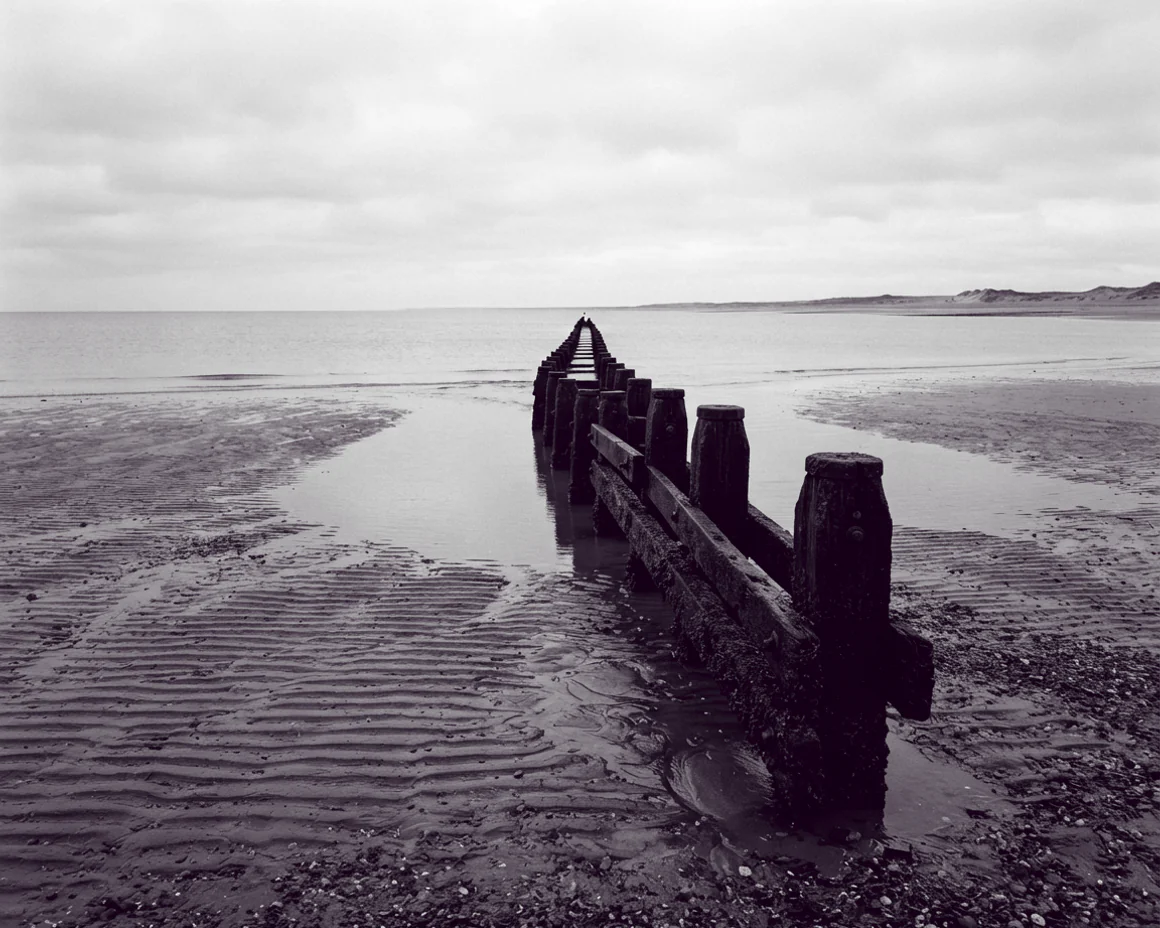
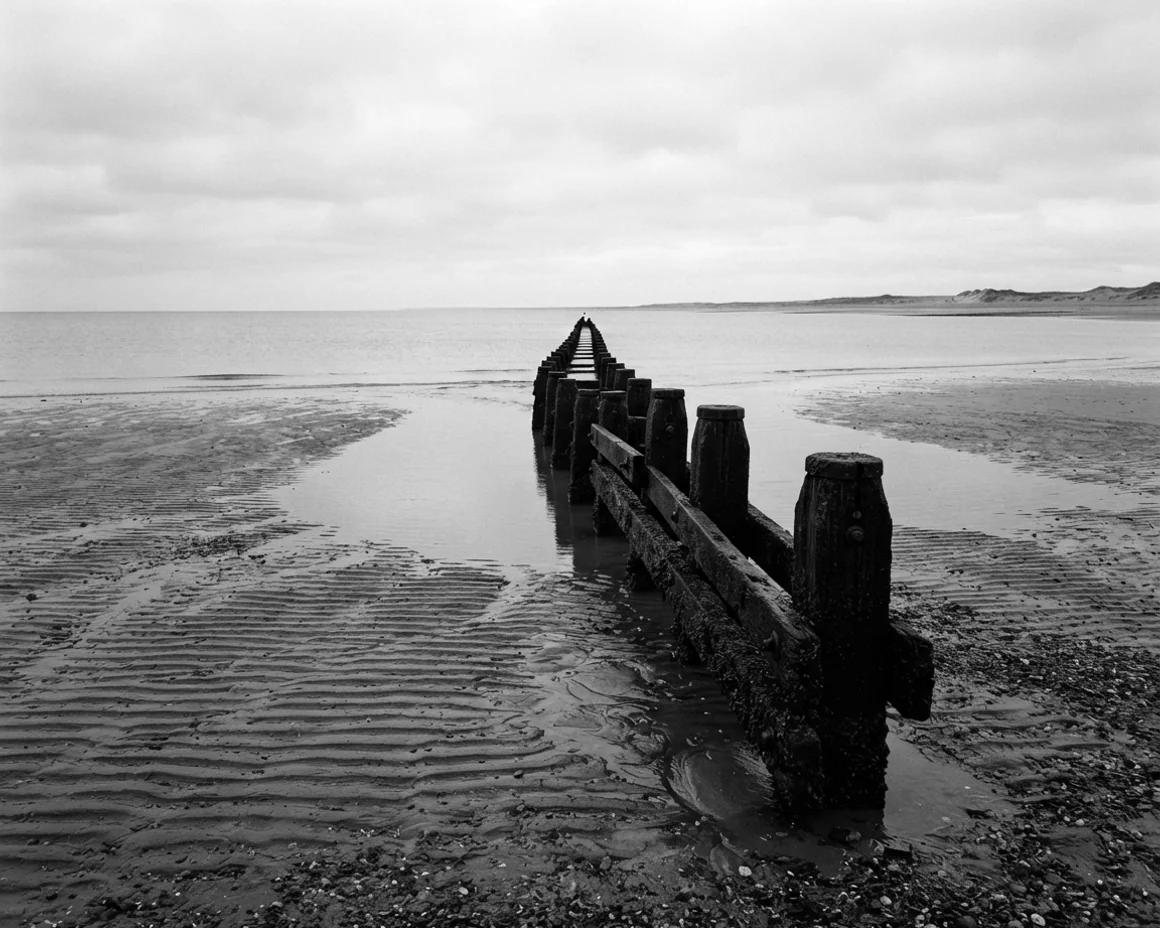
Measured
Both files above, decoded and measured a tenth of the tonal scale at a time. Chroma is CIE C*ab; the hue angle is the direction the toner moves the colour in, and it does not vary with density.
| L* band | Toned | Untoned | Hue |
|---|---|---|---|
| 0–10 | 12.96 | 0.00 | 321.8° |
| 10–20 | 12.22 | 0.00 | 322.3° |
| 20–30 | 10.06 | 0.00 | 322.1° |
| 30–40 | 8.63 | 0.04 | 322.0° |
| 40–50 | 7.24 | 0.00 | 321.9° |
| 50–60 | 5.48 | 0.00 | 322.2° |
| 60–70 | 3.51 | 0.03 | 321.7° |
| 70–80 | 0.84 | 0.00 | 321.8° |
| 80–90 | 0.05 | 0.00 | — |
| 90–100 | 0.01 | 0.00 | — |
| whole print | 4.97 | 0.00 | 322° |
The law the bath is described by: C* = 16 × (1 − L* ÷ 80), hue 322°, applied to every photograph on this site and to none of the reference print.
What happens to a sheet
- Exposed at 4×5, one sheet at a time, developed by inspection under a green safelight.
- Contact printed first. A negative that does not work at 4×5 does not work larger.
- Enlarged onto fibre-base paper, test strip, then the print, then the print again.
- Fixed twice, in two baths, because one exhausted fixer is how prints are lost.
- Toned six minutes, selenium 1:20. Rinsed, washed an hour, dried flat overnight.
- Signed on the reverse in pencil, with the negative number and the date of the print.